

Biomechanical Analysis of Tissues, Organoids, and 3D Cellular Structures using AFM
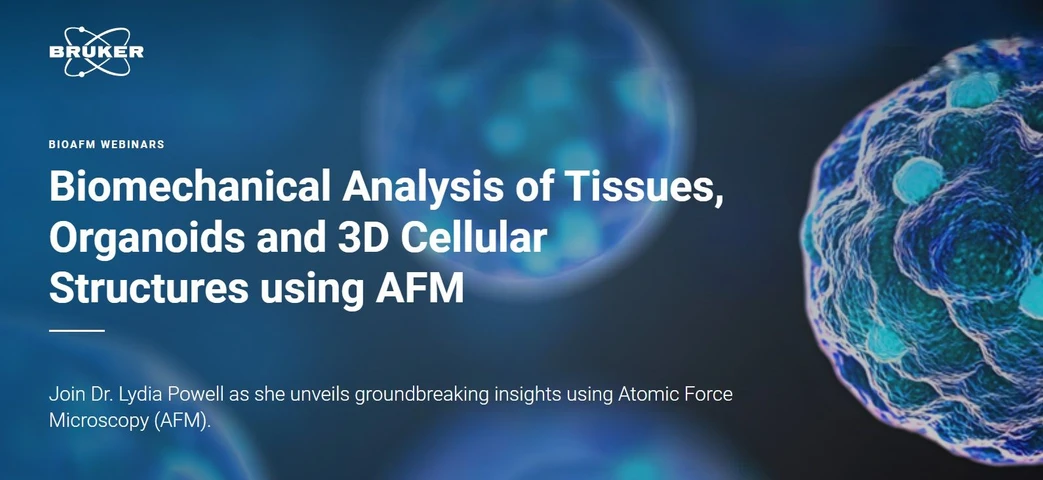
By mimicking the structure and function of organs and human tissues, spheroids, organoids, and 3D cellular models are revolutionizing medical research. AFM, an advanced multiparametric imaging technique, can provide invaluable insights into complex biological and biomechanical mechanisms in samples ranging from individual biomolecules and cells to tissues and 3D multicellular aggregates.
Dr. Lydia Powell, whose work is at the interface of engineering and biomedical sciences, will speak on using 3D spheroid cellular models to study the mechanisms of drug resistance in ovarian cancer treatment, metastasis, and chronic wound biofilm-related infections, and how this research can be translated into the design and delivery of new therapies.
Don’t miss the LIVE demonstration, where we will illustrate SmartMapping, an advanced AFM mode that allows the automated investigation of challenging, uneven samples, such as living cells, organoids, and tissues, and the flexible investigation of arbitrarily shaped mapping areas.
This webinar will include:
- A fascinating overview of how 3D models are advancing our understanding of disease and therapeutics
- SmartMapping Demo, LIVE from our labs in Berlin, Germany
- Q&A session with the team
Agenda
17:00: Welcome & Introduction
- Oilibhe Pabsch, Scientific Affairs Manager, Bruker BioAFM
17:05: AFM Mechanical Mapping of Large-Scale 3D Cellular Models
- Dr. Lydia Powell, Swansea University Medical School, Wales
17:35: Live Demo NanoWizard BioAFM
- Dr. Alexander Dulebo, Application Engineer, Bruker BioAFM
17:50: Q&A
18:00: Closing
Webinar Abstract
The dramatic rise in the use of 3D cellular in vitro models has been driven by the need to better understand the complex biological and biomechanical mechanisms occurring in disease and therapeutic treatment. 3D cellular models endeavor to mimic the cellular architecture and environment conditions found in vivo, however, standard characterization techniques fail to effectively capture the spatial biomechanics at largescale. In Swansea University Medical School, we have used Atomic Force Microscopy, together with the 3D spheroid cellular model, to unravel the role of multicellular aggregates in ovarian cancer drug resistance and metastasis within the peritoneal cavity. Furthermore, we have used the latest advancement of SmartMapping to achieve force maps of entire ovarian cancer spheroids surfaces (>150µm), revealing their heterogenous nature.
Presenter: Dr. Lydia Powell (Microbiology and Infectious Disease Group, Swansea University Medical School, Wales)
Dr. Lydia C Powell is a lecturer within Swansea University Medical School. Lydia’s research, operating at the interface between engineering and biomedical sciences, has been pivotal in understanding the biophysical and mechanical properties of complex 3D multicellular aggregates, such as bacterial biofilm structures and ovarian cancer spheroids. Lydia has translated this understanding into the design and delivery of new therapies for cystic fibrosis and chronic wound biofilm-related infections, where this research has informed the patenting and progression of novel anti-biofilm therapeutics into clinical trials (AlgiPharma AS and Qbiotics).


