

Conserving knowledge: Non-invasive manuscript analysis by means of micro-XRF and hyperspectral imaging
Telling stories and sharing information is a deeply rooted necessity of the human nature. Before the invention of written language, stories were told and preserved in the memory of people. However, with growing societies the necessity to note down not only thoughts and stories but also information aroused, resulting in the independent development of writing in different locations: the first, and most reknown was invented more than 5000 years ago in Mesopotamia, but independent from this also in other regions such as Egypt before c. 3250 BC, China before 1250 BC and Mesoamerica before c. 1 AD.
Since the development of the first written language, stories and information could be preserved on a material-based medium. From inscriptions in cuneiforms (clay tokens), bone, stone, or metal to ink applied on papyri in Egypt 3000 BC and later parchment and, finally, paper – the materials used to preserve the written information changed over time. Due to their lower costs, papyri and parchment allowed a more widespread use of writing. Earliest inks are based on carbon blacks, for example soot ink, sometimes modified with metal salts to increase drying properties, and from c. 3rd century BC iron gall ink or tannin-based inks.
Spatially resolved micro-XRF is a well-established technique for the analysis of manuscripts, as it allows for non-invasive characterisation of the writing material used. However, for materials such as carbon black inks, XRF does not provide any information. Here, additional techniques are required for identifying the material. Combining elemental information as retrieved by XRF with near infrared (NIR) transmission properties allows to identify the most important inks non-invasively.
This webinar will introduce possibilities of the analysis of writing inks with spatially resolved micro-XRF and presents recent solutions to co-register NIR transmission properties for determination of the ink’s nature.
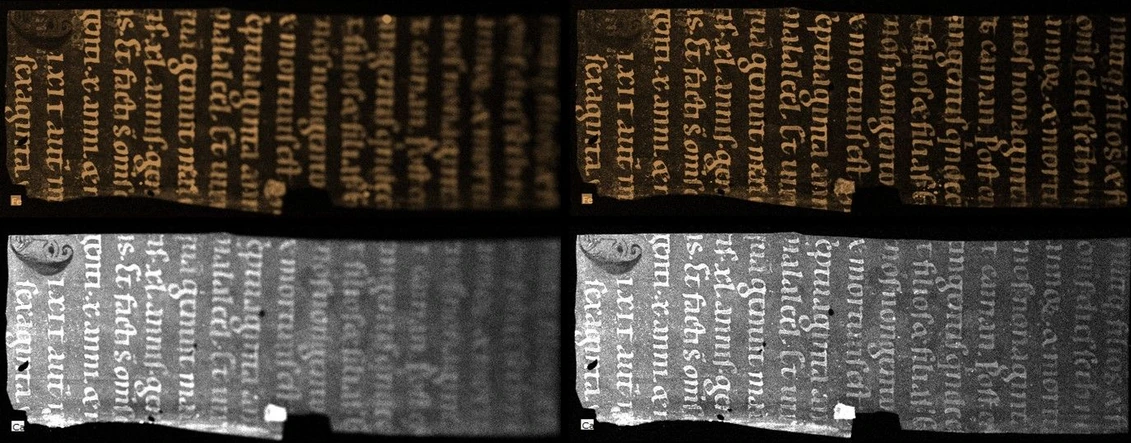 Bruker: Fig. 1 Fragment with iron gall ink writing misaligned to the focal plane of the XRF measurement. Using the patented Aperture Management System (AMS), even misaligned writings, for example from a book page, can be mapped in a legible degree.
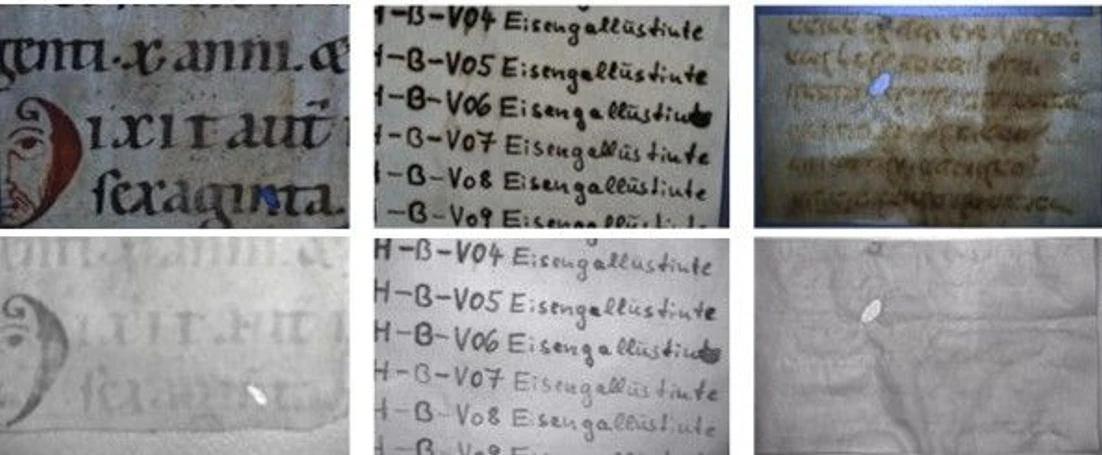 Bruker: Fig. 2 M6 JETSTREAM Special Engineering allowing to obtain stitched images of the sample both in visible light and near infrared (NIR). The sample is illuminated at 940 nm.
Who should attend?
- Everyone interested in or using XRF and NIR as a qualitative analysis technique for manuscript analyis.
- Cultural Heritage Scientists, Paper conservators, Researchers for manuscript analysis.
- M4 TORNADO, M6 JETSTREAM, CRONO, ELIO and IRIS users
Can't Attend the Live Webinar?
- Don't worry if you can't attend the live webinar - Register anyway and we will send you the webinar recording and slides shortly after the webinar broadcast.
Presenter: Dr. Roald Tagle (Global Manager Application Science, Bruker AXS)
Presenter: Mareike Gerken (Application Scientist, Bruker AXS)


