

Overcoming high matrix sample analysis challenges by optimizing ICP methods
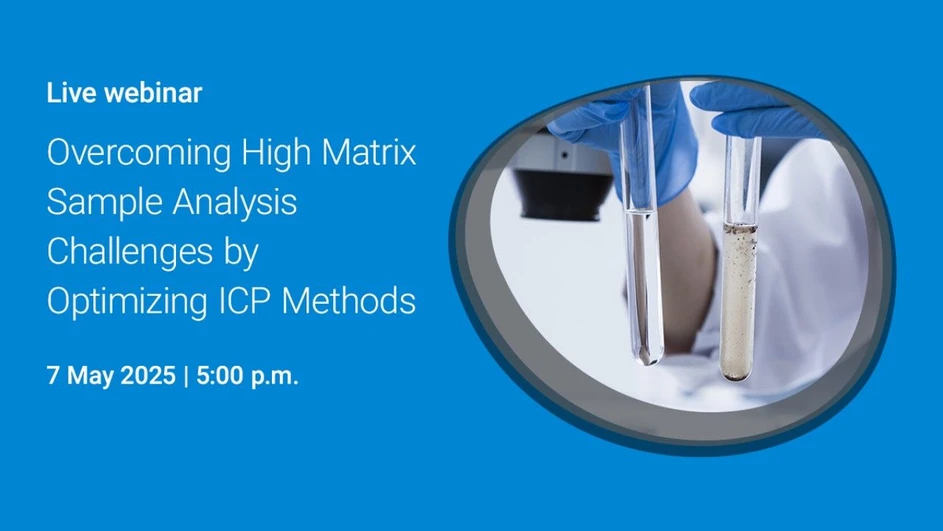
Performing trace and ultra-trace elemental analysis is important to meet regulations in various industries including environmental and food testing. However, often the presence of high total dissolved solids (TDS) in samples introduces challenges in spectroscopy analysis such as spectral interferences, nebulizer blockages, and the need for frequent dilutions. These issues can result in sample re-runs and increased instrument maintenance.
Discover an innovative solution that prioritizes both the hardware and software of Inductively Coupled Plasma-Optical Emission Spectroscopy (ICP-OES) and Inductively Coupled Plasma-Mass Spectrometry (ICP-MS) instruments, that can help analysts generate high-quality data easier and more quickly with less user intervention.
Join Dr. Raimund Wahlen, Product Specialist at Agilent Technologies, and Dr. Pierre Burckel, Application Engineer in Atomic Spectroscopy, at Agilent Technologies as they introduce the IntelliQuant feature on Agilent ICP platforms. Learn how this semiquantitative analysis tool can quickly provide a full picture of the entire sample composition for method development and thereby guide the analyst in deciding which wavelengths, or isotopes, are the best options for target analytes or internal standard elements. Different high TDS nebulizers are compared and evaluated in terms of their sensitivity, precision, tolerance to total dissolved solids, particle size handling, and maintenance requirements. Finally, automated hardware features to address high levels of dissolved solids in solutions will be discussed.
Key learning objectives
- Discover strategies for dealing with high TDS content in samples
- Find out how to select the best sample introduction components for different sample types
- Learn how to identify and address spectral interferences in unknown samples
- Understand how automation can address dilution of high matrix samples and improve sample throughput
Who should attend?
- Lab managers, QC lab technicians, researchers and analysts working in contract testing labs, food testing, environmental testing, public health and public analyst labs.
Certificate of attendance
- All webinar participants can request a certificate of attendance, including a learning outcomes summary, for continuing education purposes.
- If you view the on-demand webinar, you can request a certificate of attendance by emailing [email protected].
Presenter: Dr. Raimund Wahlen (Product Specialist, Agilent Technologies)
Dr. Raimund Wahlen is the Atomic Spectroscopy Product Specialist for Agilent Technologies in the UK and Ireland. Before joining Agilent in 2009, he worked as a Research Specialist at LGC Ltd, UK with the main focus of developing high-accuracy methods for analysis of organometallic species by LC- and GC-ICP-MS, which were used for the certification of new organometallic speciation reference materials. During this time, he completed a PhD on hyphenated ICP-MS techniques with Prof Kym Jarvis at Kingston University.
Presenter: Dr. Pierre Burckel (Application Engineer in Atomic Spectroscopy, Agilent Technologies)
Dr. Pierre Burckel holds a PhD in Geochemistry from the University of Versailles-Saint-Quentin, where he developed his interest in elemental and isotopic analysis through his research on past climates. As an Application Engineer at Agilent, he is responsible for developing analytical methods in atomic spectroscopy.
Moderator: Olivia Long (Editorial Team, SelectScience)


