

Peeling Back the Layers: Thickness Analysis by Means of micro-XRF
Micro-XRF instruments are primarily designed to facilitate spatially resolved chemical analysis across diverse sample types. However, the technique also lends itself to a variety of additional purposes, such as transmission imaging, energy-dispersive Laue mapping, and, most commonly, characterization of layer systems.
As X-rays penetrate a sample, their intensity decreases with depth, influenced by their energy and the material’s composition. Similarly, X-rays emitted from within the sample must pass through overlying layers, so their detected intensity depends on both their energy and the makeup of those layers.
This dual attenuation effect means emitted X-rays carry information not just about the sample’s chemical composition, but also its internal structure — such as chemical boundaries or layered regions.
In this webinar, we will revisit the basics of the well-established technique of layer analysis by means of micro-XRF. We'll examine both the possibilities and limitations of the technique, including how factors like out-of-focus measurements and tilted surfaces can impact results. Additionally, we will motivate the intended use cases for different quantification approaches and present a variety of application examples.
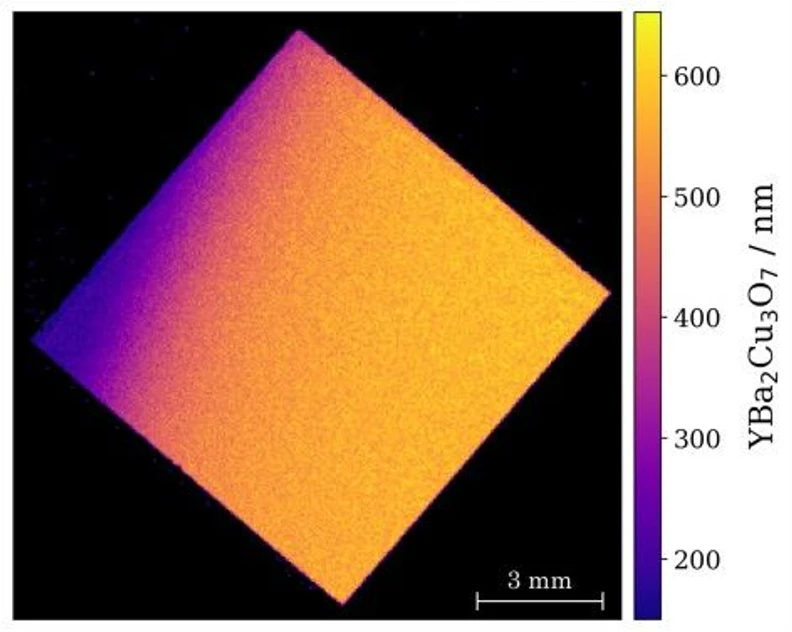 Bruker: Commercially grown YBa2Cu3O7 on Al2O3. Standard-free quantification of thickness; sold as 500 nm.
Who should attend:
- Micro-XRF users in industry, R&D, semiconductors;
- Interested parties in materials science, metallurgy.
Presenter: Falk Reinhardt (Senior Application Scientist micro-XRF, Bruker AXS)
Presenter: Dr. Christian Hirschle (Application Scientist micro-XRF, Bruker AXS)


