

Advancing Battery Research with Benchtop NMR and EPR
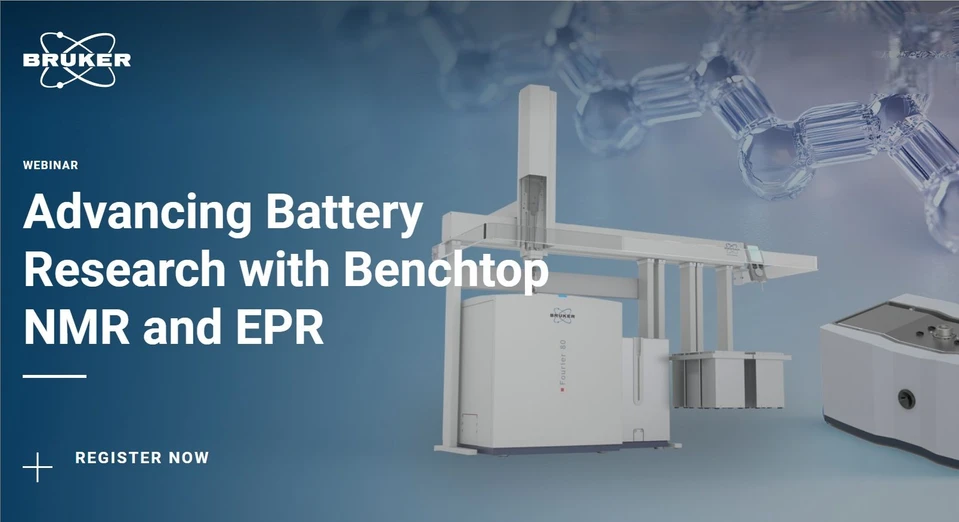
Batteries are central to the transition toward sustainable energy, but improving their performance, safety, and longevity demands a deep understanding of their chemical and physical processes. Nuclear Magnetic Resonance (NMR) and Electron Paramagnetic Resonance (EPR) spectroscopy are two complementary techniques that provide unmatched insights into the behavior of both electrodes and electrolytes at the molecular and atomic levels.
This webinar will showcase how modern benchtop NMR and EPR instruments make these powerful techniques more accessible to researchers, enabling in-depth characterization directly in the laboratory. The session is structured around three presentations:
Benchtop NMR for electrolytes: an exploration of how NMR can be applied to study the composition, degradation, and dynamics of battery electrolytes.
Benchtop EPR for electrodes and electrolytes: an introduction to the unique information EPR reveals about paramagnetic species in battery components
Operando NMR and EPR for electrochemistry: an overview of the collaborative research with Radboud University demonstrating how combining these techniques together shed light on electrochemical processes, with a focus on redox flow batteries.
Through these presentations, you will learn how benchtop spectroscopy can help identify degradation pathways, monitor ion mobility, characterize electrode materials, and understand redox mechanisms in energy storage systems.
Whether you are investigating fundamental battery chemistry or optimizing materials for practical applications, this webinar will show you how benchtop NMR and EPR can be seamlessly integrated into your research. The speakers will share recent case studies, collaborative results, and practical considerations for applying these techniques effectively.
Join us to discover how accessible, high-quality spectroscopy at the benchtop can advance your battery research and contribute to the development of next-generation energy storage technologies.
What to Expect
- NMR for electrolyte analysis: composition, degradation & dynamics
- EPR for paramagnetic species in electrodes & electrolytes
- Operando NMR/EPR for electrochemistry: overview of collaborative research on redox flow batteries with Radboud University
Presenter: Dr. Niels Karschin (Application Scientist, Bruker BioSpin)
Dr. Niels Karschin earned his Ph.D. developing NMR methods for structure characterization on both small molecules as well as proteins. He joined Bruker BioSpin as an Application Scientist in 2022, where he focuses on making advanced methods more accessible for routine users, particularly on benchtop systems.
Presenter: Dr. Kalina Ranguelova (Senior EPR Applications Scientist, Bruker BioSpin)
Dr. Kalina Ranguelova has been an EPR Applications Scientist at Bruker BioSpin Corporation since 2011. She completed her Ph.D. at the Bulgarian Academy of Sciences, where her research focused on the structure of inorganic copper complexes using electron paramagnetic resonance (EPR) spectroscopy. After holding research positions at CUNY and the National Institute for Environmental Sciences, where she studied free radical biology and EPR spin trapping as a method for measuring reactive oxygen species (ROS), she joined Bruker. In her current role as an Applications Scientist, she focuses on developing new applications for EPR in various fields and providing customer support and training.
Presenter: Giu Silva Testa (PhD Candidate at Magnetic Resonance Research Center)
Giu A. Silva Testa has been a PhD candidate at the Magnetic Resonance Research Center since July 2023, under the supervision of Dr. Evan Wenbo Zhao. Their research focuses on applying magnetic resonance techniques to explore the properties of Redox Flow Batteries (RFBs). To advance this research, Giu developed a novel dual benchtop NMR-EPR flow setup, which also has broader applications for studying other electrochemical systems. Giu holds a bachelor’s degree in Chemistry from the University of Barcelona (2016–2021) and a master’s degree in Physical Chemistry from Radboud University (2021–2023).


