

Expanding the 4D‑STEM toolbox for advanced materials characterization
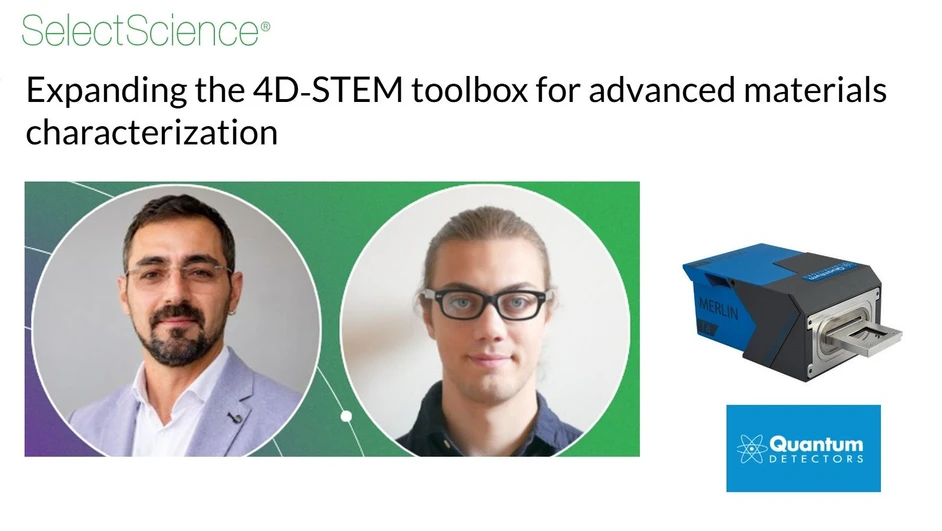
Four‑dimensional scanning transmission electron microscopy (4D‑STEM) is enabling new approaches to extract structural, crystallographic and phase information in advanced electron microscopy. As applications expand across materials science and nanotechnology, researchers increasingly require detector technologies that balance speed, dynamic range, timing precision and efficient data handling.
In this SelectScience® webinar, Dr. Stefano Vespucci, a leading Thermo Fisher Scientific Staff Scientist specializing in detector development and 4D‑STEM innovation, will present recent experimental results using a Timepix4‑based prototype detector in a TEM environment.
He will be joined by Dr. Matúš Krajňák, an Application Scientist at Quantum Detectors and Honorary Research Fellow at the University of Glasgow, whose research spans hybrid pixel detectors, Lorentz microscopy and ultrafast imaging.
Together, they will compare frame‑based and data‑driven acquisition modes, discuss key detector performance considerations, and share examples demonstrating how Timepix4 capabilities support high‑resolution 4D‑STEM. They will also explore the future potential of event‑driven acquisition and timestamping technologies for next‑generation electron microscopy.
Certificate of attendance
- If you attend the live webinar, you will automatically receive a certificate of attendance, including a learning outcomes summary, for continuing education purposes.
- If you view the on-demand webinar, you can request a certificate of attendance by emailing [email protected].
Webinar details
- Cost: Free to attend
- Location: Online
- Duration: 60 minutes per session
Registration is required to secure your place. If you register but can’t attend live, you will receive a link to the on‑demand recording once it becomes available
Who should attend?
This event is perfect for:
- Professionals working with 4D-STEM
- Academic researchers
- Material characterization experts
- Research scientists
- Engineers
- Technology developers
What will this webinar cover?
- How Timepix4 technology can be applied in electron microscopy and how
- detector performance influences 4D-STEM acquisition strategies.
- The key differences between frame-based and data-driven acquisition approaches
- Practical application examples demonstrating Timepix4-enabled workflows
- Emerging opportunities enabled by event-driven readout and timestamping
Join the webinar to get answers to these questions:
- How can Timepix4 detector technology be integrated into modern electron microscopy workflows?
- In what ways does detector performance shape 4D-STEM acquisition strategies?
- What are the key differences between frame-based and data-driven acquisition in 4D-STEM?
- Which practical 4D-STEM experiments demonstrate the benefits of Timepix4-enabled workflows?
- How can event-driven readout and timestamping transform next-generation electron microscopy?
Speaker: Dr. Stefano Vespucci (Staff Scientist, Thermo Fisher Scientific)
Dr. Stefano Vespucci holds a PhD in Physics from the University of Strathclyde, where he worked on Medipix/Timepix-based detector technology for diffraction studies in SEM. He joined Thermo Fisher Scientific in 2018 and is currently a Staff Scientist and Project & Technical Lead in Advanced Technology. His work focuses on electron microscopy, detector development, 4D-STEM, and the translation of emerging technologies into practical microscopy applications. Dr. Vespucci has contributed to and led R&D projects involving electron microscopy applications, hardware and software development, and new characterization methods.
Speaker: Dr. Matúš Krajňák (Application Scientist, Quantum Detectors)
Dr. Matúš Krajňák is an Application Scientist at Quantum Detectors and an Honorary Research Fellow at the University of Glasgow. With a strong postdoctoral background in advanced electron microscopy, he specializes in the use of hybrid pixel detectors for 4D-STEM, Lorentz microscopy, and electron diffraction, and has co-authored multiple peer-reviewed papers on detector technology and ultrafast imaging methods.
Moderator: Olivia Long (Editorial Team, SelectScience)
Olivia Long is a science editor specializing in pharmaceutical and applied science. She has a BSc in Pharmacology, and an MSc in Neuroscience, where she investigated neuro‑oncology drug‑resistance pathways using patient‑derived cell models. Her laboratory experience spans R&D hygiene testing, controlled‑environment sample production, and protocol development, giving her a broad understanding of analytical workflows and the scientific principles.


