

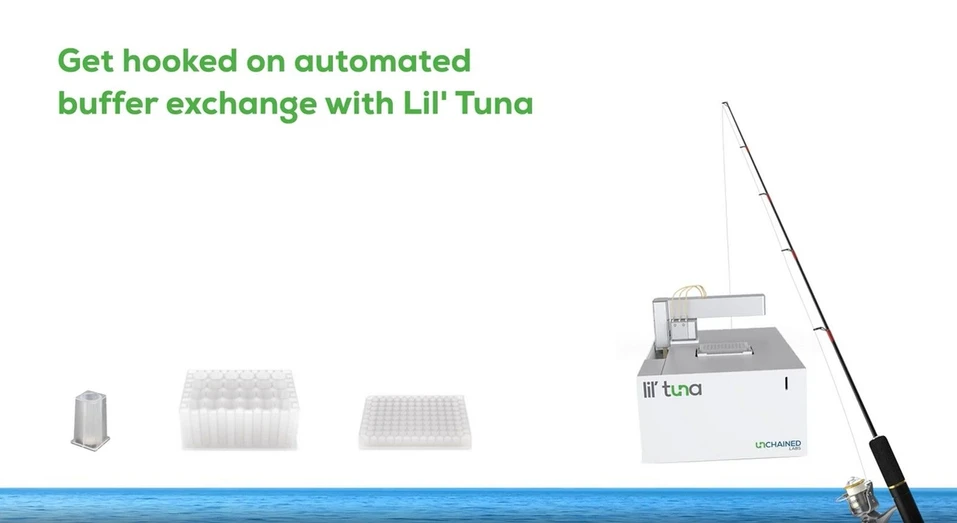
Get hooked on automated buffer exchange with Lil’ Tuna
The Problem
Buffer exchange and sample concentration stand between you and everything else you need to get done — but traditional methods are slow, manual, and impossible to fit into an automated workflow. Just a few samples can keep you tied up for hours and as the throughput goes up, buffer exchange and concentration become the bottleneck of therapeutic development.
The Solution
Lil' Tuna is the first fully automated, plate-based benchtop buffer exchange system built for proteins, nucleic acids, and gene therapy vectors at any scale. Lil’ Tuna concentrates or exchanges in 96-well or 24-well Unfilter plates for high throughput or up to 6 individual samples in Unas — all with ≥96% recovery. Its pressure-based ultrafiltration/diafiltration approach keeps things flowing efficiently, tracks sample volumes and accurately adds buffer throughout, handling every step of the exchange cycle automatically from start to finish.
The Proof
In this seminar, you’ll see how easy it is to run buffer exchange or concentration experiments on Lil’ Tuna. Whether working with a full plate of 96 samples or with just a few, the experiment setup is straightforward. Scope the different types of experiments: a buffer exchange with optional concentration or simply concentration by itself. Finally, take a peek at how Lil’ Tuna packs all it needs to integrate into automation workflows with universal API software, a sample stage designed for easy access and simple template import functions.
Presenter: Brian Haldeman (Product Manager, Lil' Tuna, Unchained Labs)
Brian Haldeman is Product Manager for Lil' Tuna at Unchained Labs. Prior to this role, he was a Field Application Scientist supporting biophysical characterization of proteins and viral vectors. Brian received his Ph.D. in Biochemistry from the University of Nevada, Reno where he studied the mechanics of muscle contraction. His research utilized single-molecule microscopy, pre-steady-state kinetics, protein affinity and binding characterization, and protein isolation techniques.


