

Elemental Analysis of Battery Components and Materials Using Handheld XRF, Micro-XRF and SEM-EDS
What to expect?
Batteries are essential for modern technology, powering devices from smartphones to electric vehicles. Ensuring the quality and safety of batteries is crucial to prevent failures and hazards. Quality control throughout the batteries’ life cycle involves examining the anode, cathode, electrolyte, and separator materials, as well as materials to be recycled.
As a manufacturer of handheld XRF, micro-XRF, and SEM-EDS instruments, we aim to compare how these different analytical techniques can address various analytical questions about battery components:
- Handheld XRF: Quickly identifies elemental composition and detects impurities in raw materials and finished components.
- micro-XRF: Provides detailed elemental mapping of relatively large areas, useful for analyzing specific features or inclusions in battery materials.
- SEM-EDS: Offers high-resolution imaging and precise elemental analysis, crucial for verifying material composition and structural integrity.
- SEM based micro-XRF: As an add-on tool, combines the advantages of EDS and micro-XRF.
In this webinar, we will present results obtained with the different analytical techniques on battery precursor materials and various manufactured electrodes. We will explain the obtained results in terms of elemental sensitivity, detection limits, sample volume/area, spatial resolution and measurement time, while also addressing general limitations that originate from the different physical principles behind the techniques. Understanding these differences helps in selecting the right method for specific analytical needs.
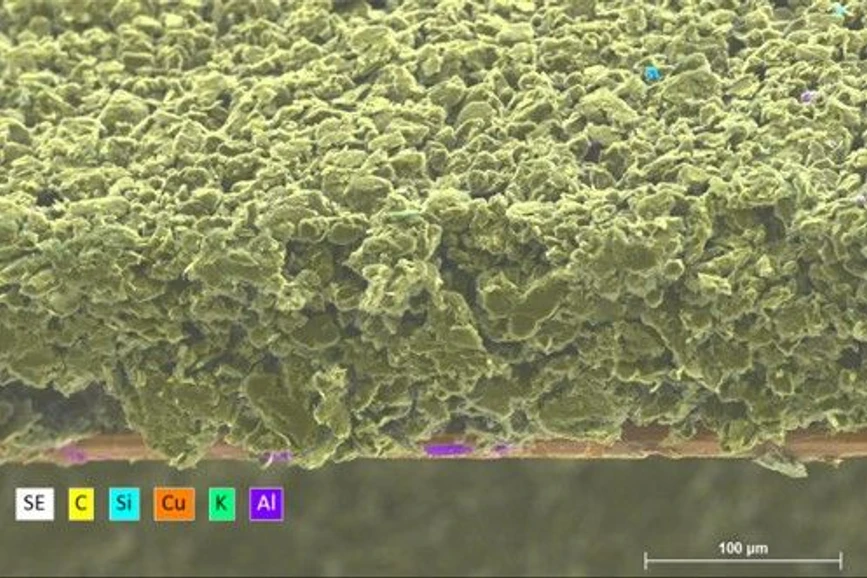 Bruker: Graphite electrode on Cu-foil viewed in cross section: EDS mapping with QUANTAX FlatQUAD system reveals contaminants within short measurement time.
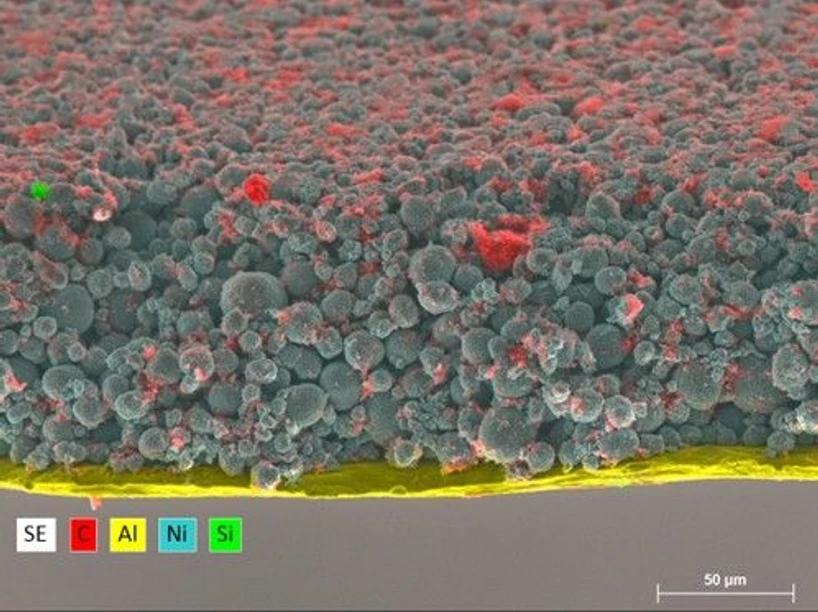 Bruker: Battery cathode (NMC on Al-foil) viewed in cross section: EDS mapping with XFlash® FlatQUAD detector reveals contaminants within short measurement time with no need for sample preparation
Live Session 1*
- Tuesday - June 17th, 2025
- 10 am CEST / Berlin
Live Session 2*
- Tuesday - June 17th, 2025
- 5 pm CEST / Berlin
Who should attend?
- Battery technology experts and engineers
- People interested in learning about the differences between X-ray and electron excitation-based elemental analysis
Presenter: Dr. Igor Németh (Application Scientist EDS, Bruker Electron Microscope Analyzers)
Presenter: Falk Reinhard (Application Scientist micro-XRF, Bruker)
Presenter: Dr. Kathrin Schneider (Application Scientist Handheld XRF, Bruker)
Presenter: Dr. Yang Yang (Application Scientist EDS, Bruker Electron Microscope Analyzers)


